
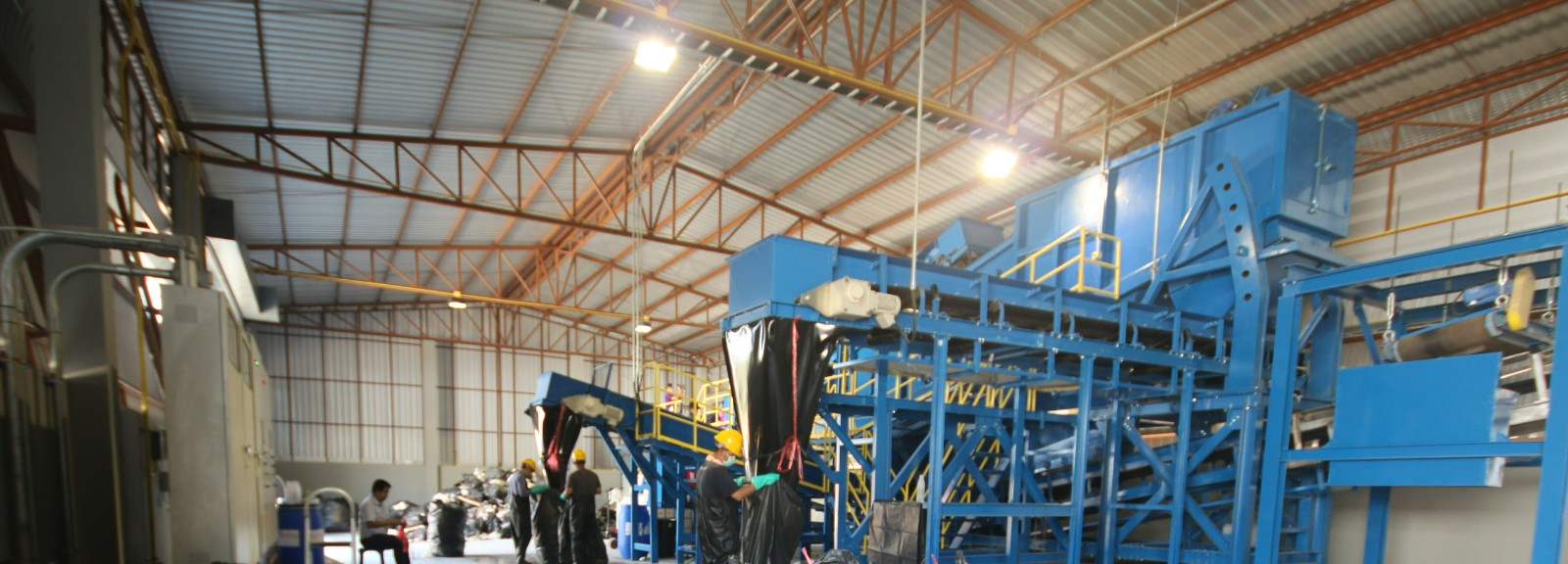
Waste composition influences the steps and the technologies applied: as countries develop, the MSW generated tends to become a complex mixture of materials that demands complex technology-based sorting process to extract clean fractions. Such technologies must have the ability to sort an increasingly diverse range and volume of materials regardless of size, moisture content and/or contaminant level.
This high level of variation in waste streams usually leads to a combination of technologies that are applied to successfully separate the waste. The info below briefly describes some of the main technologies employed in waste sorting plants.
Waste screening
• Trommel screen
1. An angled rotating cylinder with holes that allow waste of a given size to fall through.
• Disk Screen
2. A bed of vertical-spaced discs that transports large waste items but allows smaller items to drop through the gaps.
• Oscillating screen
3. A vibrating/oscillating declined bed that allows smaller waste to pass through while transporting larger waste to the end.
Air separation
• Zigzag air classifier
4. Waste is dropped through an upward air current in a zig-zag shaped flue. Light waste is blown to the top, while heavier waste falls to the bottom
• Rotary air classifier
5. A trommel screen separator with an air current that captures the lightweight fraction.
• Cross-current air classifier
6. Waste is fed on a conveyor and dropped through an air stream. The light components are blown horizontally to a collection point and the heavy components drop through.
• Suction hood
7. Sucks light weight waste directly from the conveyor belt.
Ballistic Separation
8. A steeply inclined bed with a perforated plate screen deck, with alternate vibrating elements. Light fractions are lifted by cams to the top of the bed, heavy fractions fall to the bottom.
Film grabber
9. Waste is accelerated onto a rotating drum with spikes. These hook plastic film and let other waste drop.
Magnetic separation
10. Magnets either lift ferrous metal from the waste, or hold ferrous metal to the conveyor while other waste is allowed to drop.
Eddy current separation
11. Eddy currents are used to push non-ferrous metals with magnets into separate collection points, with non-metallic waste falling into another.
Manual Sorting
12. Employees are positioned beside the conveyor and manually remove materials either in positive or negative sorting.
